
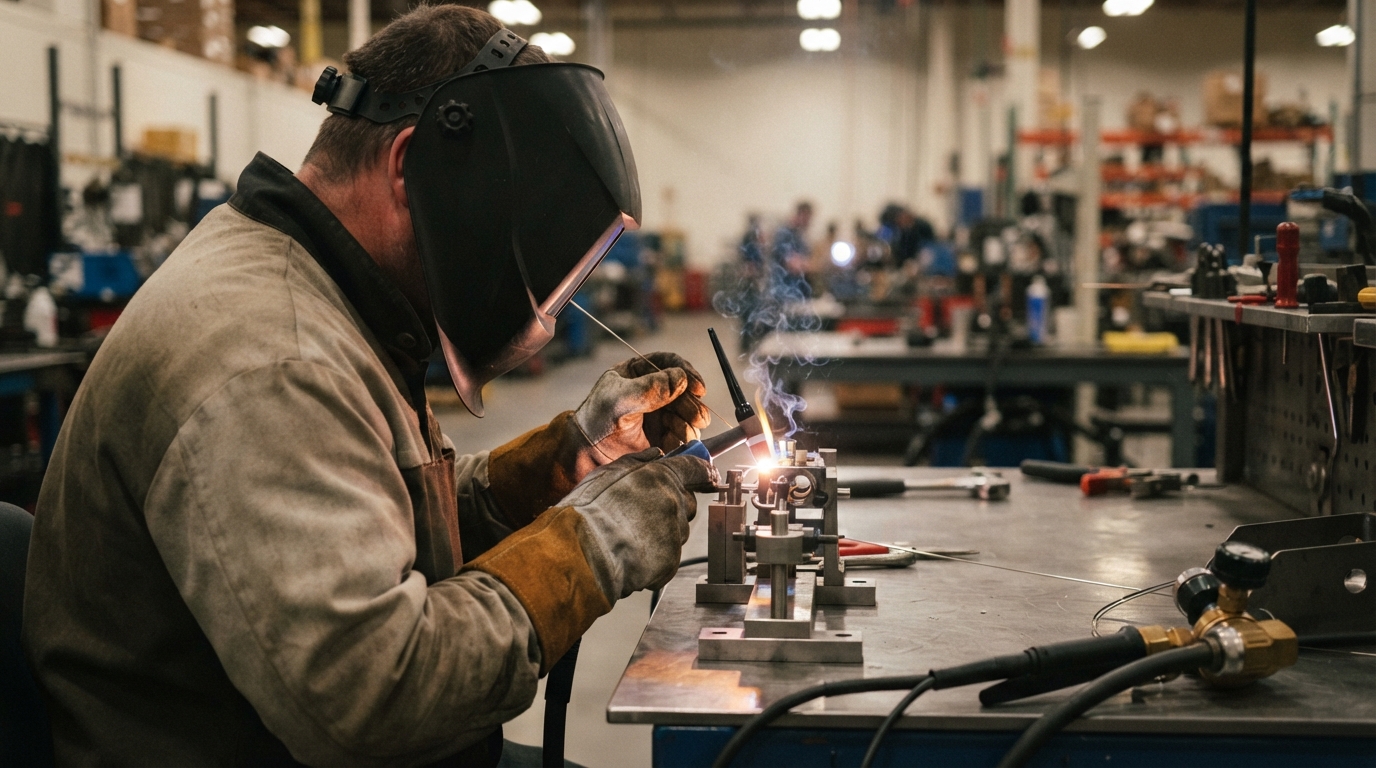
Snapshot:
-
Production welding services combine repeatable, high-volume welding with strict quality controls to reduce part defects and production delays.
-
Key techniques include TIG welding, micro laser welding, and microscopic TIG welding, each suited to different precision requirements.
-
Choosing a certified provider with documented quality systems is the most reliable way to protect both schedule and product integrity.
Manufacturers across the USA rely on production welding to keep assembly lines moving without sacrificing part quality. When defects or delays enter the equation, the downstream costs in rework, scrap, and missed shipments can be significant.
What Production Welding Services Actually Involve
Production welding is distinct from one-off fabrication. It offers efficient and cost-effective fabrication, ensuring increased productivity and reduced downtime, while combining different materials with precision to create strong, durable products that meet strict quality requirements.
Capabilities typically include high-volume production welding, production fabrication services, and TIG welding services, though the right method depends on part geometry, material, and tolerance requirements. A well-equipped production welding line can handle orders of varying sizes for industries like medical devices, gun components, gas and oil, and more.
The three most common precision techniques used in U.S. production environments are:
-
Microscopic TIG Welding: Skilled technicians use state-of-the-art equipment to perform microscopic TIG welding, enabling precise and intricate welding on small-scale components and assemblies, particularly beneficial for medical device manufacturing and gun components.
-
Micro Laser Welding: Advanced micro laser welding capabilities achieve welds in highly confined spaces with minimal heat input, ideal for applications where precision and minimal distortion are paramount.
-
General TIG Welding: General TIG welding services address larger-scale projects where consistent, clean welds are required across higher part volumes.
How Defects Form and Why They Delay Production
Weld defects are rarely random. Typical weld defects include undersized welds, insufficient weld length, and weld profile issues such as undercut, overlap, slag inclusions, and elongated porosity. Each of these requires rework or rejection, adding time and cost to the production cycle.
A project focused on production only is susceptible to quality issues, and poor quality happens when established quality practices are not followed. The American Welding Society (AWS) documents that defect feedback loops are essential: it is essential to sit down with welders after a reject and explain the position and possible causes of specific flaws, because without this open dialogue, poor-quality welds continue without answers about why they are happening.
The table below compares common production welding problems with their typical root causes and prevention strategies:
|
Problem |
Root Cause |
Prevention Strategy |
|
Porosity |
Contaminated base metal or shielding gas loss |
Pre-weld cleaning, gas flow verification |
|
Incomplete fusion |
Incorrect travel speed or heat input |
Procedure qualification, operator training |
|
Distortion |
Excessive heat-affected zone |
Laser welding, fixturing, controlled heat input |
|
Dimensional variation |
Inconsistent setup between runs |
Certified welding procedures, documented parameters |
Certifications That Protect Quality and Schedule
Certification is one of the clearest indicators that a production welding provider has the systems in place to catch problems before they become delays. ISO 13485 certification and FFL certification give clients peace of mind in the quality of their welds.
Quality at the forefront means a commitment to continuous improvement and investment in ongoing training to stay current with the latest welding techniques and technologies, giving clients confidence in the reliability and performance of welding services.
Experienced teams hold the highest industrial welding certifications, giving manufacturers peace of mind that the welding service is right for their industrial applications. For regulated industries such as medical devices, this is not optional — it is a baseline requirement.
Choosing a Production Welding Partner in the USA
When evaluating providers, consider these factors:
-
Industry experience: Providers serving industries across the USA, including aerospace, automotive, and defense, bring cross-sector knowledge that reduces the learning curve on new part types.
-
Process range: Services should span welding repairs and revisions on injection molds and dies, proof of concept and R&D, and production welding for all industries, along with single-part requests.
-
Volume flexibility: The ability to scale from prototype to full production run without changing providers eliminates handoff errors and schedule risk.
-
Quality documentation: Certified procedures, inspection records, and traceability reports are non-negotiable for regulated sectors.
Frequently Asked Questions
What is the difference between production welding and custom fabrication? Production welding involves repeatable welds performed across many identical or similar parts, using documented procedures and quality controls. Custom fabrication typically addresses one-off or low-volume parts with less process standardization.
Which welding method is best for small, precision components? Micro laser welding is best for applications requiring welds in highly confined spaces with minimal heat input, particularly where precision and minimal distortion are paramount.
How does ISO 13485 certification affect production welding quality? ISO 13485 is a quality management standard specific to medical device manufacturing. Providers holding this certification maintain documented procedures, traceability, and corrective action systems that directly reduce defect rates across all production runs, not just medical parts.
What industries use production welding services most? Production welding plays a critical role across various industries, from medical device manufacturing and general industrial applications to gun component manufacturing and more.
For manufacturers evaluating precision production welding in the USA, provider certification, process range, and quality feedback systems are the three variables most directly tied to defect reduction and on-time delivery. Micro Weld, Inc offers ISO 13485-certified production welding services spanning microscopic TIG, micro laser, and general TIG welding for medical device, industrial, defense, and gun component applications nationwide. Contact their team to discuss project requirements and request a quote.