
Recap:
-
OSHA mandates fall protection training for any worker exposed to fall hazards, governed by 29 CFR 1926.503 (construction) and 29 CFR 1910.30 (general industry).
-
Training must cover hazard recognition, proper use of protection systems, and rescue procedures — and must be delivered by a competent person.
-
Both online and on-site formats are accepted, making compliance accessible for workers across all industries nationwide.
Fall protection training gives workers the knowledge they need to protect themselves when working at heights, and OSHA requires it for any employee who might be exposed to fall hazards. For employers, understanding exactly what those requirements demand — and how to meet them — is the first step toward a compliant, safer job site.
Why Fall Hazards Demand Formal Training
Fall protection has been the most-cited OSHA standard for 15 consecutive years, with 5,914 violations in fiscal year 2025 alone. Fall Protection Training Requirements (29 CFR 1926.503) ranks sixth on the same list, with 1,907 violations. These numbers reflect a persistent gap between having equipment on site and ensuring workers know how to use it correctly.
Providing equipment without training is not compliance. Employers who skip formal instruction face citation risk, potential site shutdowns, and — most critically — preventable worker injuries. OSHA requires fall protection when employees work at elevations of 4 feet in general industry, 6 feet in construction, and 8 feet in longshoring operations.
Key OSHA Standards That Govern Fall Protection Training
Compliance requires alignment with OSHA’s fall protection training standards — 29 CFR 1926.503 for construction and 29 CFR 1910.30 for general industry — as well as the ANSI/ASSP Z359 fall protection standards. The two regulatory tracks differ in their height thresholds but share the same core training obligations.
According to the OSHA fall protection standards page, State Plans are OSHA-approved workplace safety and health programs operated by individual states or U.S. territories, with most covering both private sector and state and local government workers. State Plans are required to have standards and enforcement programs that are at least as effective as OSHA’s and may have different or more stringent requirements.
Some jurisdictions impose stricter requirements than the federal standard. New York City’s Department of Buildings, for example, requires 8 hours of dedicated fall protection training for workers entering the city’s construction industry.
What the Training Must Cover
Employers must provide training to any worker required to use personal fall protection systems or to work in areas where fall protection is required, including employees using guardrails, safety nets, personal fall arrest systems, positioning systems, or travel restraint systems.
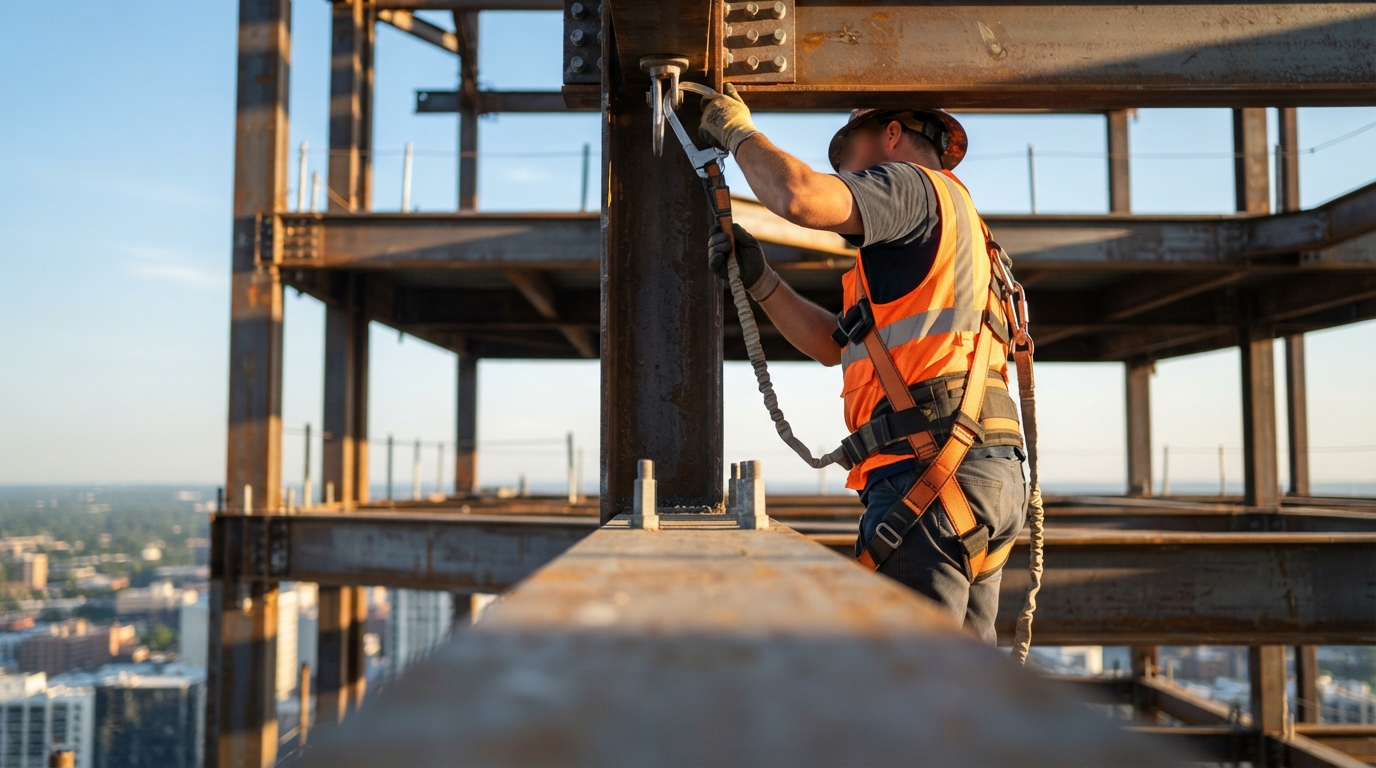
At a high level, fall protection training must cover: the nature of fall hazards present in the work area; correct procedures for erecting, maintaining, disassembling, and inspecting fall protection systems; and the proper use and operation of the systems that will be used on the job — guardrails, harnesses, nets, warning lines, and similar equipment.
OSHA 1926.503 requires training by a “competent person” for all workers exposed to fall hazards. OSHA defines a competent person as one capable of identifying existing and predictable hazards in the surroundings or working conditions, and who has authorization to take prompt corrective measures to eliminate them.
Retraining Triggers
OSHA does not prescribe a specific refresher frequency for fall protection training. Still, retraining is required whenever there are changes to fall protection systems or equipment, changes to work conditions that make prior training outdated, or evidence that an employee’s knowledge or application of fall protection is inadequate.
|
Trigger for Retraining |
Standard Reference |
|
New or changed fall protection equipment |
29 CFR 1910.30 / 1926.503 |
|
Worksite conditions change |
29 CFR 1926.503 |
|
Employee demonstrates inadequate skill |
29 CFR 1910.30 |
|
State plan imposes stricter schedule |
Varies by state |
Online vs. On-Site Training: Choosing the Right Format
With online fall protection training, workers can engage in high-quality courses without having to take time away from their work — making it a practical solution for those in construction, manufacturing, or any job that involves working at height. On-site training, by contrast, allows a competent person to assess site-specific hazards directly and demonstrate equipment use in context.
OSHA fall protection training is a critical component for both general industry workers and construction workers facing common fall risks on the job. Courses should adhere to OSHA standards 29 CFR 1926 (construction) and 29 CFR 1910, including 1910.28-30 (general industry).
A qualifying fall protection training course should align with OSHA Standards 1910.28-30, 1910.140, and 1926.500-503, and include topics such as hole covers, safety nets, guardrail systems, fall restraint systems, falling object protection, and more.
A well-structured online fall protection training course provides in-depth education on harnesses, guardrails, anchorage systems, and best practices to reduce the risk of falls from heights. Workers in industries such as construction, roofing, transportation, and industrial operations all fall within OSHA’s scope.
Frequently Asked Questions
Who is required to complete fall protection training? OSHA requires fall protection training for any employee who might be exposed to fall hazards. The scope is broad: if a worker could fall from an elevated surface, they need training before that exposure occurs.
Does fall protection training expire? OSHA does not set a fixed expiration date, but retraining is mandatory when equipment or site conditions change, or when an employee shows signs of inadequate knowledge or skill.
Can training be completed online? Online and on-site training is available nationwide and anywhere in the world from accredited providers, provided the course content meets the applicable OSHA standard and is overseen by a competent person.
What happens if an employer skips fall protection training? When OSHA identifies safety violations, they have the authority to charge fines, shut down your job site, and require you to get fall protection certification for every employee exposed to a fall risk before you may reopen.
Get Compliant with Verified Fall Protection Training
Meeting OSHA’s requirements does not need to be complicated. Hazwoper Center offers both online and on-site fall protection training that aligns with 29 CFR 1926.503 and 29 CFR 1910.28-30, serving workers in California, New York, New Jersey, Texas, Florida, and across the nation. Training is available online throughout the US as well as on-site for different OSHA programs including Fall Protection Training. Whether your team works in construction, industrial operations, or transportation, verifying that your training program meets the applicable federal and state standards is the clearest path to protecting workers and avoiding costly citations.